Care That Helps You Move
In this module, you will read and see more about:
Care That Helps You Move
I. Physiotherapy
Physiotherapy and OI
Physiotherapy (PT) is recommended to strengthen muscles and bones, improve mobility, and enhance overall physical function. It helps relieve pain, increase joint range of motion, and improve strength.
PT plays an important role in your treatment plan by supporting physical abilities and fitness.
Regular exercise in PT can lead to several benefits, such as increased flexibility, stronger muscles, improved fitness, reduced joint tightness, and better joint stabilization.
- What does a physiotherapist do?
Physiotherapists can provide you with helpful strategies to manage OI. A physiotherapist will:
- Assess and monitor your mobility, your strength and your flexibility
- Show you how to improve your 🔗 physical abilities and fitness levels
- Help to decrease your 🔗 pain and 🔗 stiffness
- Improve your flexibility, movement quality, and range of motion
- Discuss with your physiotherapist ways to improve your physical health and movement
- Modalities of physiotherapy
A physiotherapist will usually give you a set of specific exercises to improve strength, stamina, mobility, independence, and to help manage your pain. These may include equipment such as weights, elastic bands, therapy balls, or a treadmill.
Physiotherapy may also involve helping you to select or make adaptations to sports and other physical activities. This will help to improve your level of fitness and your ability to perform different activities.
Other modalities to treat pain in physiotherapy might include heat, ice and transcutaneous electrical nerve stimulation (TENS). You learned about some of these strategies in All About Pain.
Want to know more about how to get active? Check out the MOvIng With Care section [ADD LINK]] in the Healthy Living module on Teens OI! You’ll find tips on how to get started, real stories from other youth, info on adapted sports, and how physical activity can help reduce pain.
II. Occupational Therapy
What is the Purpose of Occupational therapy?
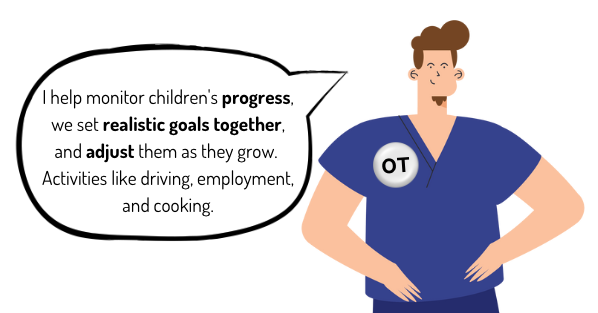
An occupational therapist (OT) can help you function your best at home, school, work, and play. Occupational therapy can help to maximize your strength, endurance, and physical function. Occupational therapy can make you more independent in your activities of daily living. As you grow, you may want to do things on your own and find a way to be independent. OT’s can help you find the equipment, modified the task or environment or strategies to achieve your goals.
What does an Occupational Therapist Do?
OTs provide assessment, treatment, and education for people with health conditions such as OI.
They can advise you on ways to adapt your activities and the physical environment around you so that you can participate more fully in school, leisure activities and work. Occupational therapists have special training in:
- Fine motor assessment and exercises to improve your fine motor skills (strengthening, eye-hand coordination, finger dexterity exercises, etc.)
- Hand function
- The design and fabrication of hand splints.
- Assess your need for equipment or devices
What are Some Common Occupational Therapy Services?
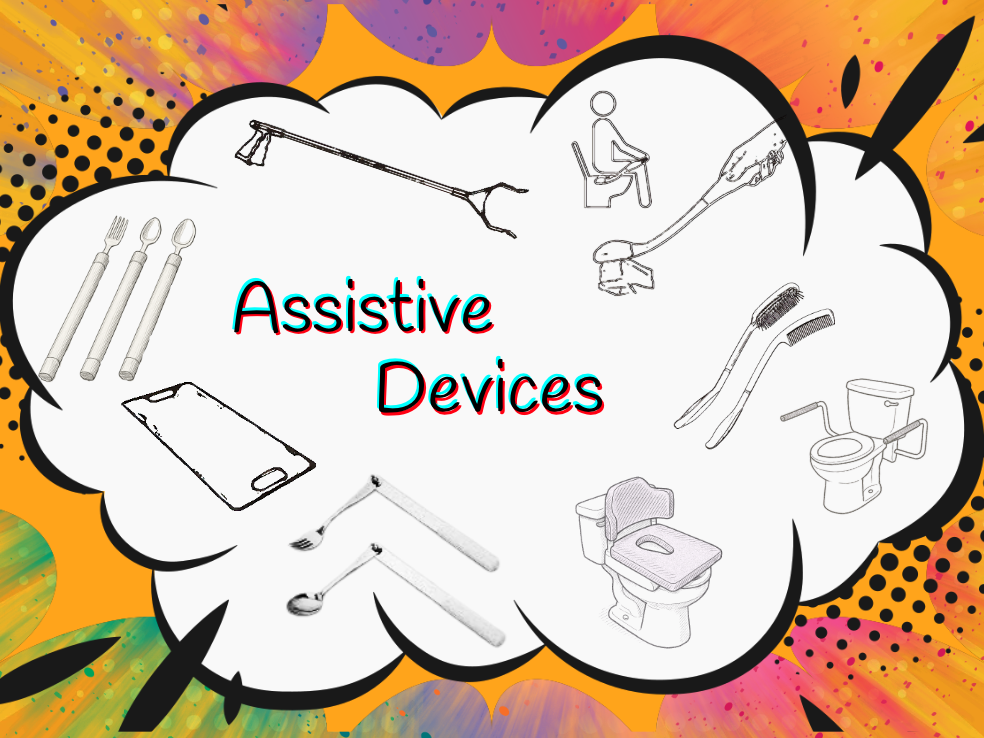
- Assistive devices/Equipment
Assistive devices can increase your participation and promote your independence in your daily activities. Assistive devices can help with getting dressed, brushing your hair (adapted hairbrush), writing, eating, and even with bathroom hygiene. This really depends on your specific needs and difficulties with your participation. Your need for such device might change depending on your level of pain or frequency of fractures. Maybe in the past, when you fractured, you didn’t mind someone else helping you or you didn’t need to move across an entire campus to get to class or go to work, but as you get older you may want to be as independent as possible, even when you are recovering from a fracture and equipment/devices can sometimes help.
Occupational therapists can recommend assistive devices. They can visit your school, home or work to see if you need any special equipment to help in your daily routines. They can change your existing equipment as needed.
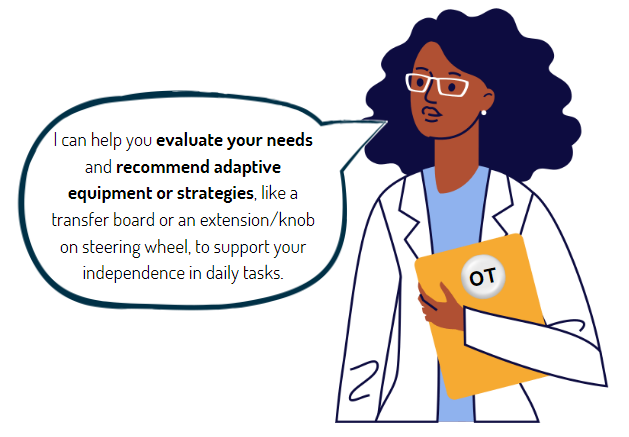
Hyperlaxity can also sometimes cause some joint pain, especially in the small joints of your hands and wrists, it’s not always a fracture! Your OT can help assess this pain and provide you with some modifications or maybe a specific splint or taping to relieve the pain while still being able to participate in your everyday activities and sports. An OT can help you evaluate your needs and recommend strategies and adaptive equipments if needed, like a transfer board, an extension/knob on steering wheel, etc.
Hyperlaxity is not all bad! Sometimes you may have some bowing or curves in the bones in your arms, which may change the way you move your arms but the hyperlaxity in your joints can help counteract those limitations so you can still do all the activities you need to do, like washing your hair, tying a ponytail, bathroom hygiene, etc.
Accessibility
- Strategies to use toilet, bath, bed, car independently
OTs can evaluate the way you get from different surfaces and provide you with ideas, techniques or equipment to help make transfers you need a little smoother and as independent as possible. The amount of assistance, equipment or modifications that you need may change depending on your fractures, surgeries, fatigue and pain. So it’s important to think about what you might need when you have a fracture, to have everything prepared so it’s ready to use if it happens.
For example, if you mainly use a wheelchair for mobility, think about getting a bed that is the same height or enough space to transfer onto the toilet. Or if you mainly walk without any aids, but are experiencing frequent fractures or pain in your legs, it might be a good idea to have a wheelchair with an elevating footrest or a walker to use when that happens. This way, you can still go to school, work, or engage in leisure activities, even if you are fractured.
OTs can also help with assessing and helping you transfer into a car, both if you have or don’t have a
fracture. Depending on your height and strength in your arms and legs, you may need some adaptations to drive. There are some OTs that have a specialized certificate that can evaluate what you need to drive a car or adapt a car. It is very important that you mention to your OT that you would like to start driving lessons or adapting a car because every province, state and country has a different process of getting your car adapted and driver’s license.
OTs are also involved in helping you decide on any home adaptations, especially to get into your house if you are using a wheelchair, bathroom and being able to cook in your kitchen. Similar to car adaptation, every province and country has different funding options or private insurance, so it’s important to ask your OT what is available where you live.
Balancing School, Work, Play, and Leisure Activities
You need to consider adapt your schedule to meet the demands of school, activities, and your social life.
If you are considering a part-time job, it is important to think about:
- the physical demands and risks of the job and the time commitment
- how can you manage these requirements
- whether adaptations are required
Advocating for yourself is important, and you are encouraged to share what OI is, how it affects you, your strengths, as well as possible adaptations to promote your autonomy.
At school and/or at work, you may need:
- modifications to ensure accessibility if you use a wheelchair or walker
- additional time to write exams or complete certain tasks, access to a computer or tablet if handwriting is difficult
- changes to the gym program
When it comes to extracurricular activities and hobbies, it’s important to think about some specific changes you can make. For instance, you might need to tweak the physical space to make it more comfortable and enjoyable. Adjusting the tasks can help ensure completion.
Your therapist or doctor can write a letter to your school/work to help you get these accommodations if needed. You will learn more tips about support in school and at work, and how to communicate in the Your Support System [ADD LINK].
- Tips for balancing school, work, play, and leisure activities
- exercise regularly. It has physical, social and emotional benefits.
- communicate with your school and healthcare team. They can help address any physical or other needs you may have.
Ask for advice from your occupational therapist or physiotherapist. They can help you if having OI is keeping you from participating in activities you really want to do.
You might want to check in with your local community center! They may have adapted activities that could be just what you’re looking for.
III. Orthotics
- Orthotics and footwear
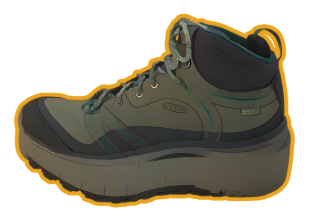
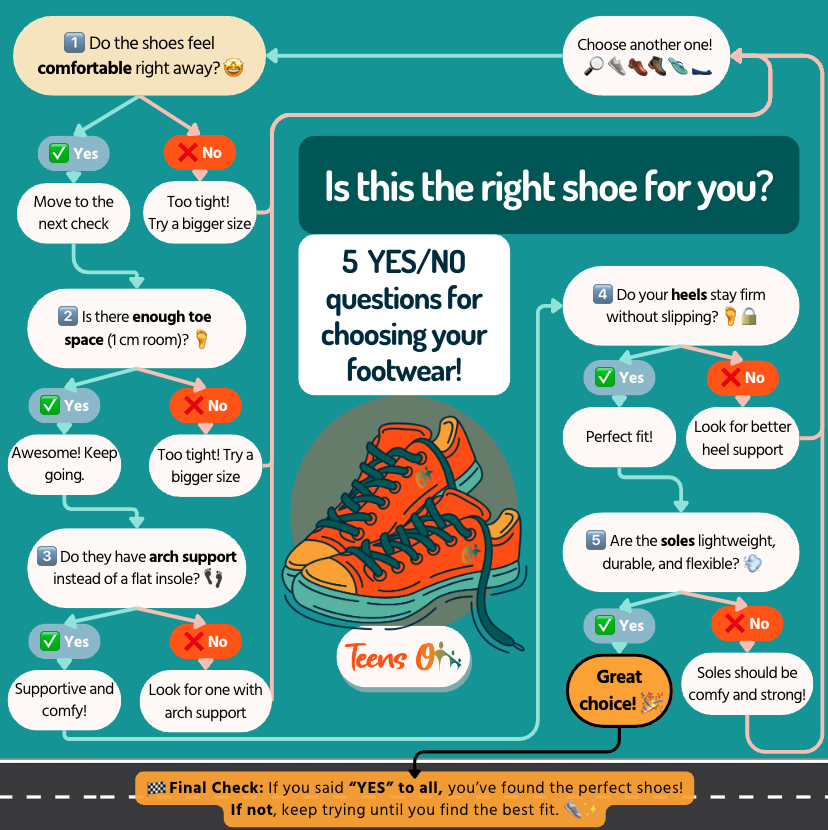
Proper footwear is key to supporting your joints and body. A good shoe should:
- Be securely fastened (like with laces, Velcro, or zippers)
- Have a firm heel support
- Have a moderately flexible forefoot
Make sure your shoes fit well! Ideally, you should be measured for both length and width.
You may try these tips for choosing the right footwear:
Most often, a supportive running or walking shoe provides enough support. However, some people may also need shoe inserts called orthotics. They can improve alignment and reduce pain. Most orthotics usually go inside your shoe and don’t look much different from regular insoles. Many people—whether they have OI or not—wear orthotics these days.
Some young people with OI have one leg shorter than the other. If the differences are significant, a shoe lift may be prescribed.
- Inner shoe lift fits inside your shoe. It can often be purchased over the counter.
- Outer shoe lifts are needed for lifts more than 1 cm. In this case, a doctor may refer you to an orthotist (a specialist who makes orthopedic devices) to modify your shoe.
There are also adaptive shoes that can make getting dressed easier! For example, the brand Billy makes shoes with a special zipper that allows you to slide your foot in and zip them up – no laces needed! These can help you feel more independent and comfortable.
Ankle-Foot Orthoses (AFOs)
An AFO is a brace that helps support your foot and ankle. It’s designed to make walking easier and more comfortable, especially if you have trouble lifting your foot or keeping your ankle stable.
There are different types of AFOs:
- Some are stiff to give strong support.
- Some bend a little to let your ankle move.
- Some are super light to feel more natural.
- Some are custom-made just for you!
If you use an AFO, it’s important to find shoes that fit well with it for the best comfort and support.