
Welcome
Welcome to Teens Taking Charge: Managing Osteogenesis Imperfecta (OI) Online, otherwise known as Teens OI.
Teens OI is designed to help you learn strategies to manage your OI and to prepare for the transition of your care into the adult health care system. Several of the sections will ask you to try out some of the new skills you will learn. By practicing the strategies, you are likely to see gradual improvements. You may start to feel better, more in control, and do more things to help manage your OI.
- Learn how to navigate the Teens OI website
- Learn about the different parts of the program
- Learn how to get started
- Set goals to better manage OI

Welcome

Educational Modules
Following this Getting Started module, there are seven educational modules. When you complete all of them, your journey will be complete.
Below is a list of the modules you will find:
- Mental Health
- Pain Management
- Social Support
- Treatment or Care for OI
- What is OI?
- Managing Symptoms
- Looking Ahead
Each module has several parts:
- Information about OI.
- Self-management strategies for OI.
- Assignments, which will help you try out your new skills.
What Can You Expect from Teens OI?
 Most teenagers with OI have faced some challenges in their everyday lives due to OI, or the treatments they require. Teens OI will help you learn about OI and different ways to cope with the challenges encountered in your daily life.
- With practice, you may see gradual improvements. You may start to feel better, more in control, and do more things.
- We recommend that you try all of the techniques, even if you do not think these techniques will be helpful right now. This way, when you complete Teens OI, you will have many techniques to choose from. You will be able to choose the ones that worked best for you for the right situation.
 Most teenagers with OI have faced some challenges in their everyday lives due to OI, or the treatments they require. Teens OI will help you learn about OI and different ways to cope with the challenges encountered in your daily life.
Goal Setting
Each person may have different goals in their lives related to school, friends, work, sports, or other hobbies. Setting goals may help you manage OI. It is important to set some goals for yourself.
🎯 A goal is something that is important to you that you want to have happen or want to accomplish.
- Some common goals may include:
- Having less pain.
- Spending more time with friends and family.
- Getting to school on time in the morning.
- Not letting OI interfere with things you want to do.
- Setting Goals for OI: Getting Started

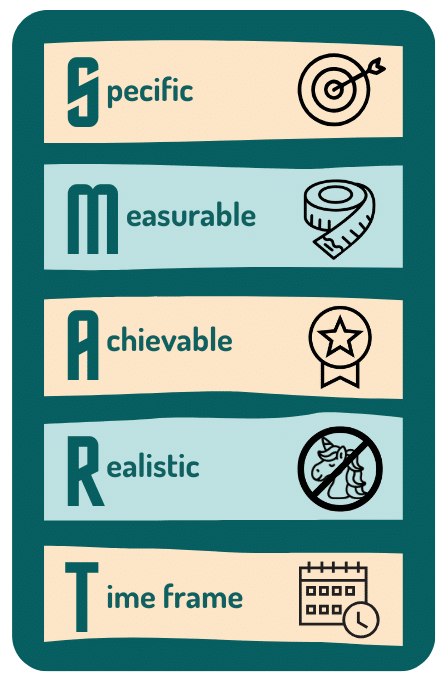
An easy way to create goals is to follow the S.M.A.R.T. method. Each letter stands for a key element to creating achievable goals. Here is how you make a S.M.A.R.T. goal:
- Be Specific. A specific goal has a greater chance of being achieved than a general one.
- Make Your Goal Measurable. Ask questions like “How many?” “How much?” or “When will this be accomplished?” This way, you can easily evaluate if you have reached your goal.
- Set an Achievable Goal. Start with a small goal and then build on it. This will help increase your chances of sticking with the goal. You can achieve almost any goal you set when you plan your steps wisely. Give yourself enough time to carry out those steps.
- Be Realistic. Set a goal that fits your lifestyle. Goals should be possible or realistic, but the goat setting should also push you. For example, going wilderness camping might be unrealistic especially when you have are recovering from a surgery. However, going on a picnic with your friends might be more realistic.
- Set a Time Frame. For when you hope to achieve your goal. By having a date to work towards, you will be more likely to put effort into achieving your goals.
- Here is an example of a S.M.A.R.T. goal:

“I will have a hot shower in the morning three times a week to reduce my morning stiffness. I hope to achieve this goal in the next month. If I can manage this in my schedule and it is helpful, I will then increase it to four times per week.”
What Are Your Goals for Managing OI?
- 1) .......................................................................................................
- 2) .......................................................................................................
- 3) .......................................................................................................
- Are your goals S.M.A.R.T. goals?